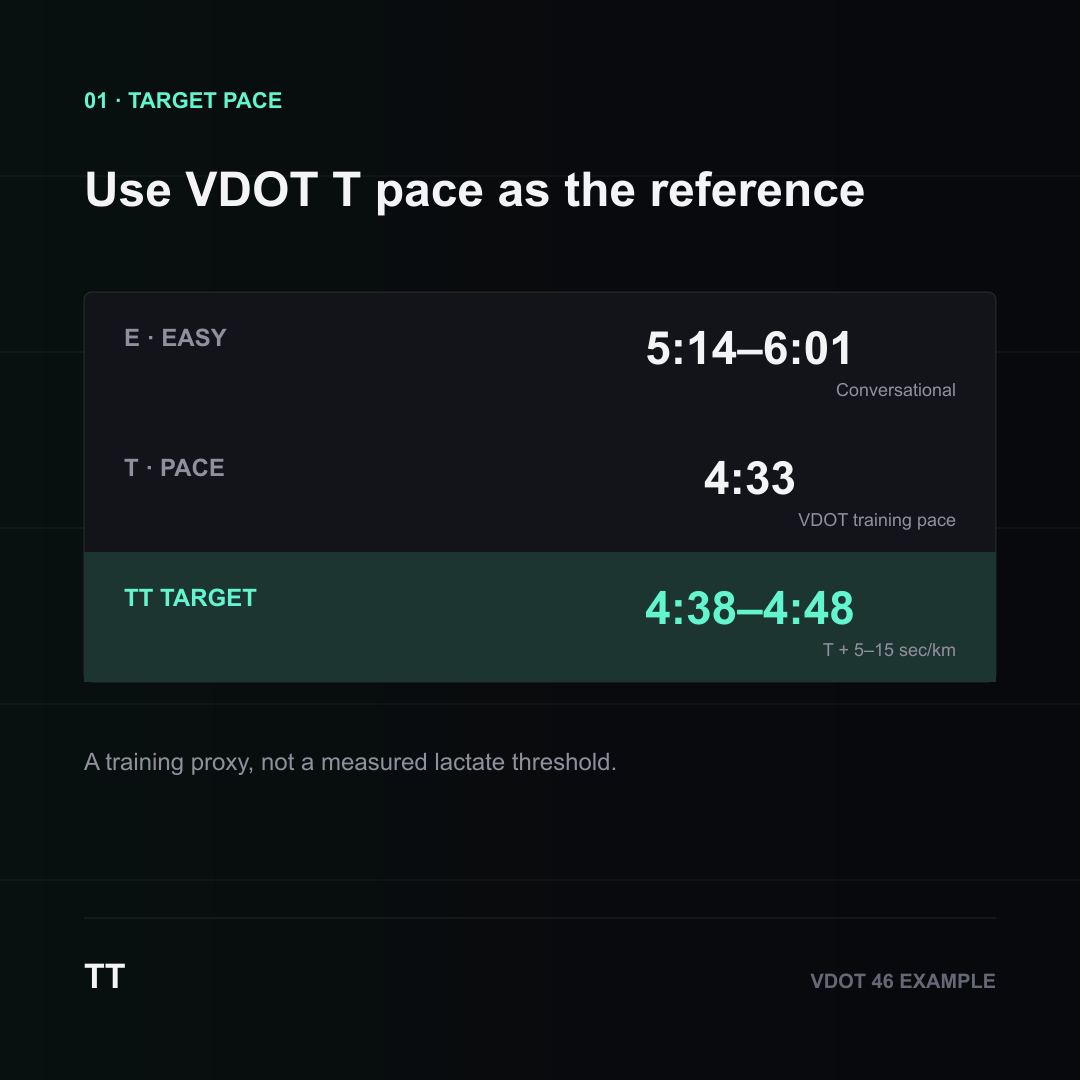
TT targets 5 to 15 seconds per kilometer slower than VDOT T pace. Weeks 1 to 3 use two sessions by default. Week 4 drops to one. Finish every rep with one more left in the tank.
If tempo sessions repeatedly drift above their planned intensity, running faster may not be the answer. Lowering the target can make the repetitions easier to control.
What TT means by sub-threshold
Physiological lactate threshold is not one universal pace. The boundary varies with the definition and test. TT's T pace is a training reference calculated from a trusted current VDOT. It is not the same as a laboratory measurement of LT2.
TT sets the pilot target 5 to 15 seconds per kilometer slower than that T pace. Because the app does not measure blood lactate, heat, hills and fatigue can still push the effort too high. Slow down when breathing or form is no longer controlled.
The Norwegian model combines a large low-intensity base with lactate-controlled threshold sessions. Elite examples include two threshold sessions on the same day. TT's NSM pilot is a conservative, once-a-day product adaptation inspired by that model. Norwegian Singles Method is a product label here, not the official name of a standardized training protocol.
One rule holds the whole thing together
Finish at an intensity where you could do one more rep.
Why lower the intensity?
Controlling intensity may make planned work more repeatable than turning every session into a maximal test. Norwegian elite practice also places non-exhaustive threshold work between high volumes of low-intensity training.
That does not guarantee a faster race after four weeks. The pilot aims for consistent execution at a conservative target rather than promising a specific adaptation or result.
In other words the goal is not to run well today. It is to repeat the work for four weeks without missing.
Setting your target pace
This is where most attempts drift. "A bit slower than threshold" means something different to every runner.
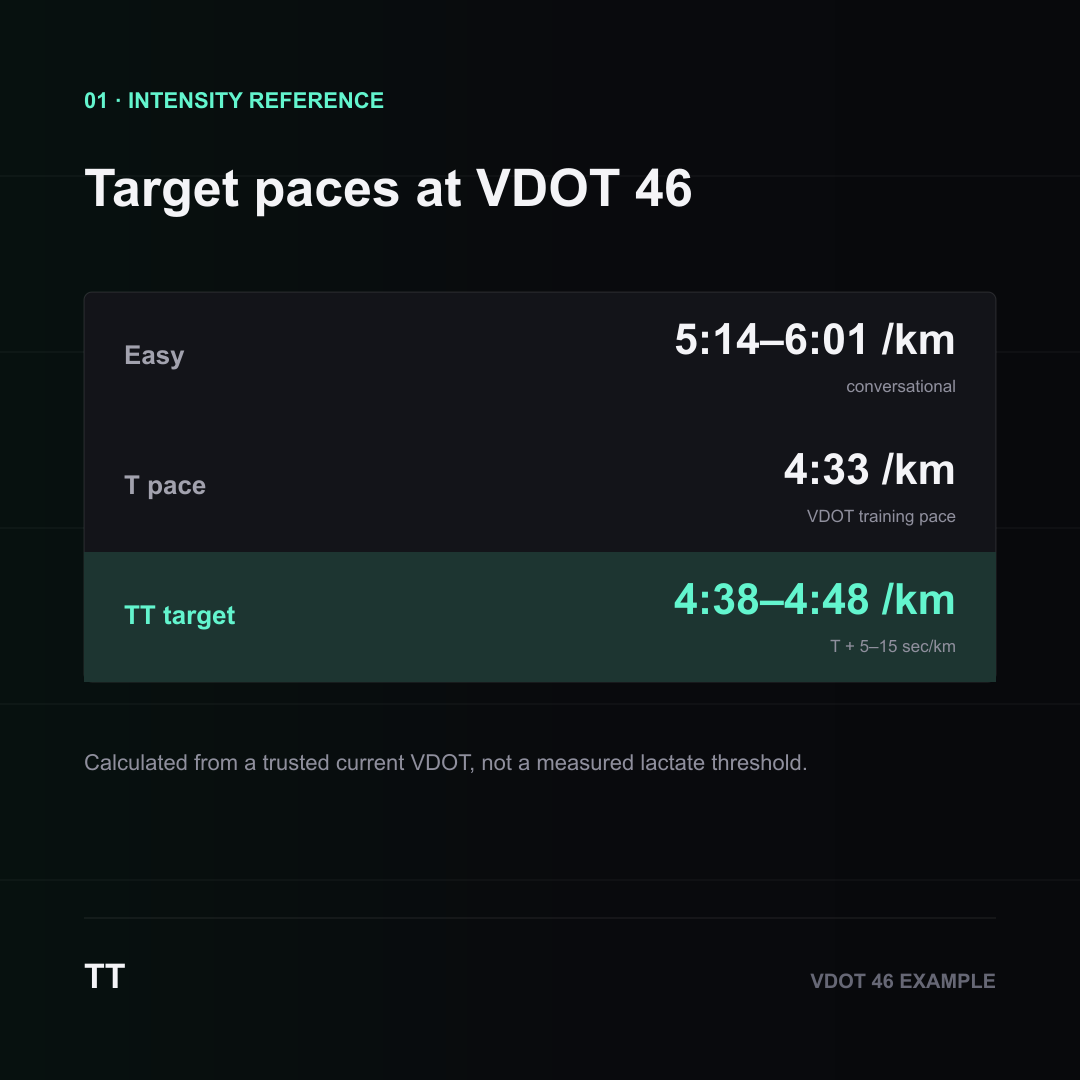
The reference is VDOT. The server prioritizes PBs. When no PB is available, it can use recent wearable VO₂max or a recent-run estimate. The data-poor default does not unlock this pilot. TT then calculates easy (E), marathon (M), threshold (T), interval (I) and repetition (R) training paces.
The sub-threshold target is one step further: 5 to 15 seconds per kilometer slower than T.
| Zone | At VDOT 46 | How it feels |
|---|---|---|
| Easy (E) | 5:14 - 6:01 /km | Conversational |
| Threshold (T) | 4:33 /km | Short phrases only |
| Sub-threshold | 4:38 - 4:48 /km | Breathing stays controlled |
The gap looks small on paper. It does not feel small. At T pace you are hanging on by the end; at sub-threshold your breathing and form hold through the final rep.
This range is a VDOT-based proxy. Measuring your actual lactate response requires separate testing.
How the four weeks are built
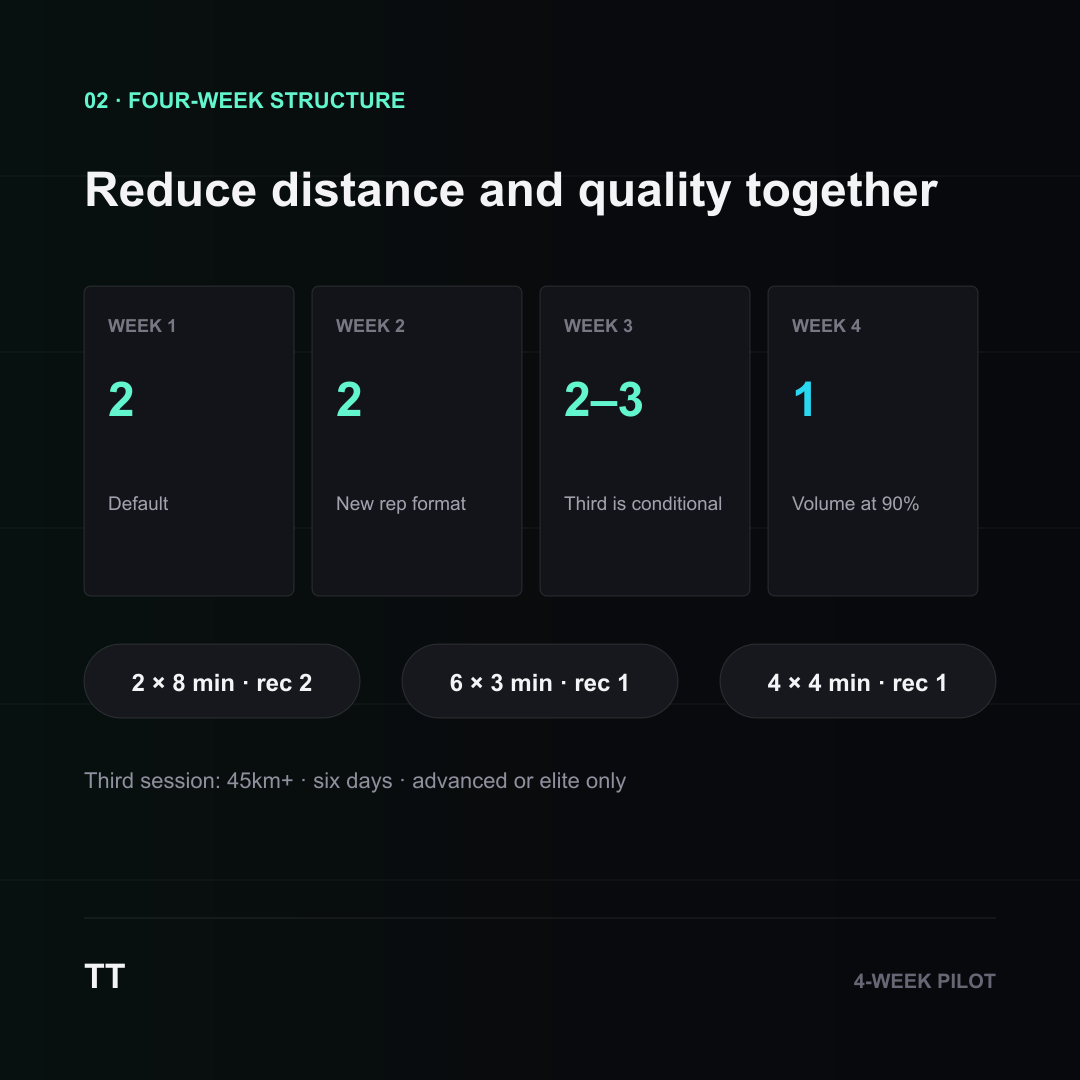
Weeks 1 to 3 default to two sub-threshold sessions. Everything else is easy running and the long run. Week 4 reduces both distance and quality frequency.
- Week 1 — two sessions plus long and easy days
- Week 2 — same shape, only the rep format changes
- Week 3 — two sessions, plus a short third one if you qualify
- Week 4 — one session with weekly volume pulled back to 90% of recent average
That third session in week 3 is only for advanced or elite runners covering at least 45km across six days. Everyone else stays at two.
The week 4 cutback is part of the implementation: weekly distance drops to 90% and the second quality session becomes an easy run.
Three session formats
2 × 8 min (2 min recovery)
The longest reps. Best for learning what controlled feels like.
6 × 3 min (1 min recovery)
Short and repeatable. Easiest format for holding pace.
4 × 4 min (1 min recovery)
For 45km+ runners. It contains 16 minutes of work.
Different lengths, same purpose: accumulate time at a controlled intensity.
Four things to protect
- Never turn the last rep into a test.
The better you feel, the more you want to push the final one. That is the moment this becomes an interval session. - Keep easy days genuinely easy.
Two quality sessions a week only work if the rest of the week recovers. Holding easy pace matters as much as holding session pace. - Do not extend the long run.
For these four weeks the long run stays comfortable and the same length. - Do not make up missed days.
Stacking a skipped session onto the next day breaks the structure.
Who can start
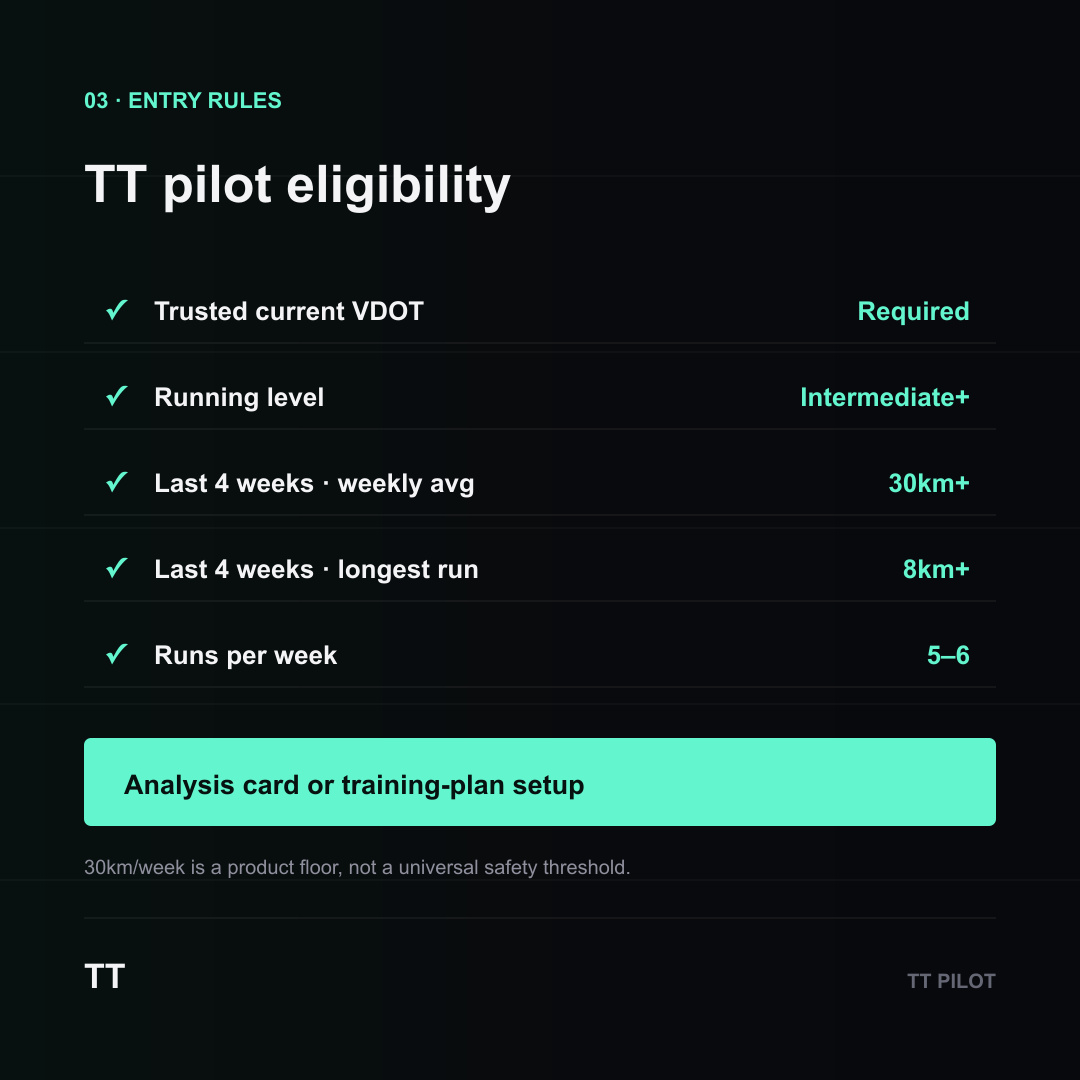
These are product entry rules. They are not universal medical safety thresholds. They keep the current session structure within recent training volume.
- A trusted current VDOT that TT can verify
- Intermediate level or above
- 30km or more average weekly volume over the last four weeks
- At least one run of 8km or more in the last four weeks
- Able to run five or six days a week
If your weekly volume is not there yet
The pilot stays locked. Do not jump straight to 30km per week; build from your current volume progressively and check again.
Now available in TT as a 4-week pilot
TT calculates the target from a trusted current VDOT and keeps the four-week schedule inside your recent training volume. The app and server both validate the entry rules and weekly structure.
Open the NSM four-week pilot card in Analysis or choose NSM pilot while creating a training plan.
Worth stating plainly
This is not a medical prescription or a lactate-tested program. If you have pain or unusual fatigue, recovery comes before the plan.
Frequently asked questions
What does TT mean by sub-threshold training?
It is TT's four-week pilot using repetitions 5 to 15 seconds per kilometer slower than VDOT T pace. It does not measure lactate threshold; the aim is to accumulate controlled work.
How do I set my sub-threshold target pace?
Take the T pace from your VDOT and add 5 to 15 seconds per kilometer. At VDOT 46 the T pace is 4:33/km, so the sub-threshold target is 4:38 to 4:48/km.
Is this the same as the Norwegian method?
No. TT's NSM pilot is inspired by lactate-guided Norwegian threshold training, but it uses one session per day and VDOT pace as a proxy rather than blood-lactate measurement.
Can I start below 30km per week?
The current TT pilot will not open below 30km per week. That number is a product-specific structural floor used to fit two quality sessions, easy runs and an 8km long run inside recent volume, not a universal medical safety threshold.
Evidence and limits
This article does not prescribe the elite Norwegian model. That model combines a high volume of low-intensity training with lactate-controlled threshold work. TT does not measure lactate and instead applies a conservative product rule to VDOT T pace.
- Casado et al., 2023 — review of lactate-guided threshold intervals and the Norwegian model
- Sandbakk et al., 2025 — survey of training organization among Norwegian world-class coaches
- Weber et al., 2023 — individual responses varied under the same fixed lactate workload
Build the block from your own VDOT
TT calculates your target from a trusted current VDOT and lays out four weeks of sessions.